Documenting Bigfoot Evidence: Field Tracks, Plaster Casts, and Scientific Observation

The Importance of Field Evidence in Bigfoot Research
In the forests, river valleys, and secluded wilderness regions of North America, Bigfoot research remains one of the most challenging fields in cryptozoology. While anecdotal sightings abound, tangible physical evidence such as footprints, hair, or audio recordings remains rare and often contested. Without carefully documented field evidence, the study of Bigfoot risks being dismissed entirely as folklore or speculation. For investigators like Chris Peyton, fieldwork is not just an exercise in exploration—it is a disciplined, scientific endeavor aimed at gathering reproducible evidence that can withstand scrutiny. Each footprint, cast, or observation represents a vital link in building a credible body of data.
The quest for physical evidence requires investigators to navigate rugged terrain under often challenging environmental conditions. Riverbeds, muddy forest floors, and soft soils provide opportunities for track preservation, but these conditions are fleeting. Rain, flooding, or human interference can erase impressions within hours or days. Chris Peyton emphasizes the importance of prompt and methodical documentation: photographing, measuring, and recording tracks as soon as they are discovered to preserve the maximum amount of data. This methodical approach is what separates casual Bigfoot enthusiasts from serious researchers pursuing verifiable evidence.
Footprints provide more than simple proof of presence—they offer a window into the anatomy, behavior, and movement patterns of the creature. Detailed observation of stride length, pressure points, toe splay, and arch height can reveal the size, gait, and weight distribution of an unknown bipedal entity. Environmental factors must also be taken into account, as soil type, moisture content, and terrain slope can dramatically affect the appearance of a print. Accurately interpreting these impressions requires both experience and patience, balancing field intuition with rigorous measurement and documentation practices.
Field evidence becomes particularly compelling when linked to a broader historical and regional context. Chris Peyton often cross-references new discoveries with historical accounts of sightings or previously documented tracks. These comparisons help to identify patterns of movement and potential habitats over time. When multiple tracks display consistent morphology or recur in similar locations, it provides a stronger indication of an ongoing, elusive population rather than isolated anomalies. Each track, therefore, has the potential to contribute not just to an individual investigation, but to a larger body of knowledge about the species’ behavior and distribution.
Ultimately, the discipline of field research in Bigfoot studies rests on meticulous observation, careful recording, and ethical preservation of evidence. Each step—from identifying a track in the wild to capturing its features for analysis—requires deliberate care to maintain scientific integrity. Chris Peyton’s approach exemplifies this philosophy, demonstrating that cryptozoological fieldwork can adhere to standards of observation, documentation, and analysis that are recognizable to the broader scientific community. By following these methods, researchers can begin to move Bigfoot study beyond anecdote and toward credible, evidence-based inquiry.
Observing Nature’s Clues in the Field
Field observation is the cornerstone of credible Bigfoot research, requiring patience, focus, and detailed knowledge of local wildlife. In the Pacific Northwest and other regions where Bigfoot sightings are reported, investigators encounter a variety of environmental challenges, from dense undergrowth to unpredictable weather. Chris Peyton emphasizes that identifying a potential track is only the first step; the true task lies in careful observation and documentation. Each footprint must be measured, photographed, and analyzed in its environmental context before any further interaction. This methodical approach ensures that the evidence retains its scientific value.
When Peyton discovers a track in a riverbed, he begins by carefully examining its size, shape, and depth. These characteristics provide initial clues about the anatomy and potential weight of the creature. He compares the impressions against reference guides of known wildlife, such as bears, elk, and deer, to rule out misidentification. Particular attention is paid to features like toe alignment, arch structure, and heel width, which can distinguish an unknown bipedal species from conventional animals. Even subtle variations in depth and pressure distribution may reveal how the foot contacted the substrate, offering insight into locomotion and gait.
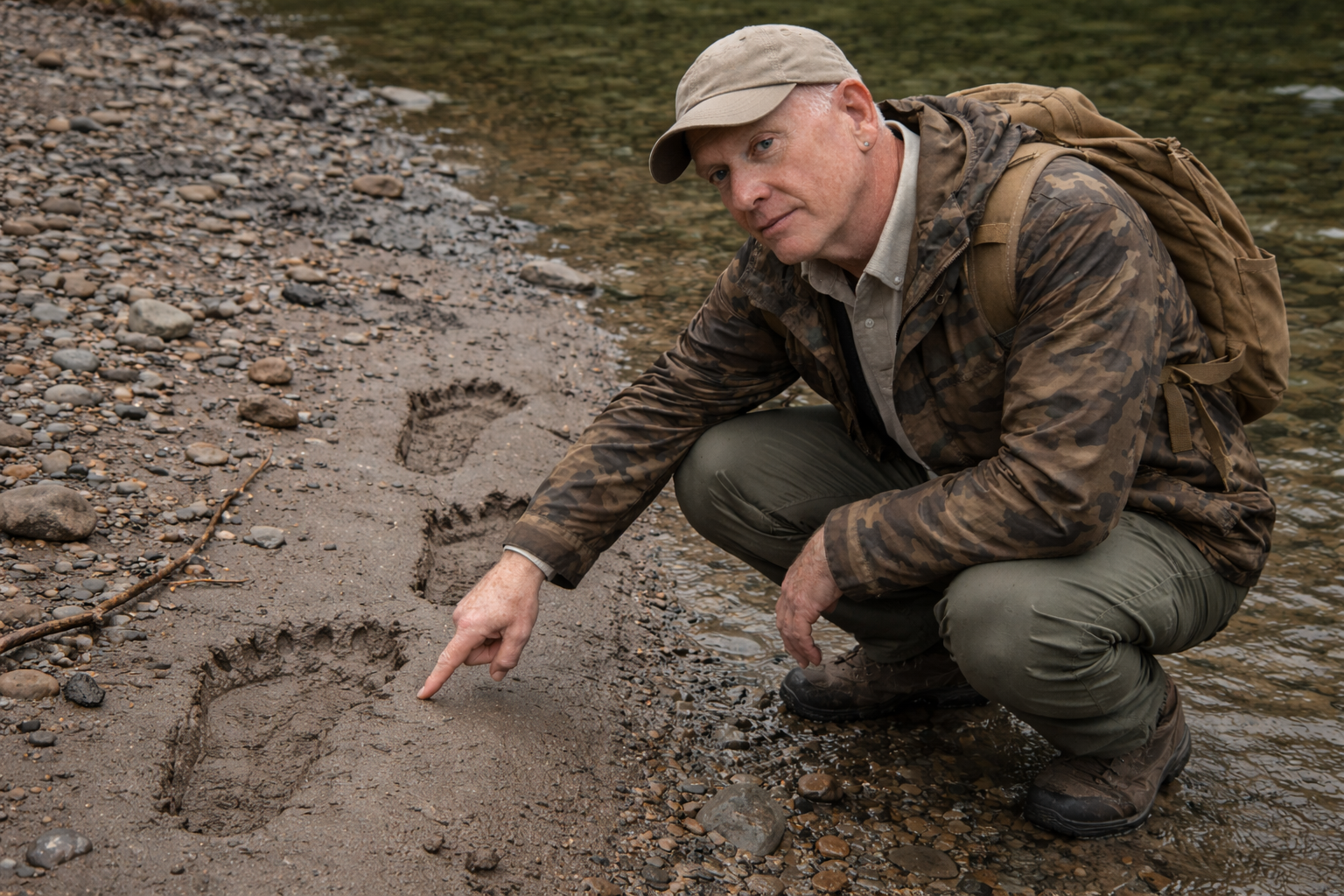
Pointing out an obvious attempt to hoax Bigfoot prints
Environmental context plays an equally critical role. Riverbeds, with their fine silt and sediment, can preserve intricate details of a track for days, sometimes weeks. However, factors like water flow, erosion, and nearby vegetation can distort impressions. Peyton meticulously records all these variables, taking multiple photographs from varying angles to ensure the track’s true dimensions are captured. Additional notes include soil composition, moisture level, and evidence of surrounding disturbance, which are essential for distinguishing authentic tracks from accidental or misleading impressions.
Consistency across multiple tracks strengthens the investigative process. On one expedition, Peyton observed a series of large, bipedal footprints along a riverbank. By analyzing stride length, foot placement, and depth, he inferred the height and weight of the individual moving through the area. Each print displayed uniform morphology, which reduced the likelihood of misidentification or coincidence. Over time, repeated observations in the same regions revealed patterns of movement and potential habitats, demonstrating that systematic fieldwork produces cumulative and meaningful data.
Documenting tracks in the field also requires attention to temporal factors. Fresh impressions indicate recent activity, whereas older, weathered prints can provide insights into the patterns of passage over days or weeks. Differences in size, shape, or depth between prints may suggest multiple individuals, age variations, or even seasonal changes in movement. Peyton’s field notes often include subtle distinctions between impressions, which can later be cross-referenced with historical sightings or casts from other locations. This combination of careful observation, environmental awareness, and documentation forms the foundation for credible Bigfoot field research, moving the work beyond anecdotal stories toward systematic scientific inquiry.
Making a Plaster Cast: Preserving Evidence
After identifying and documenting a potential Bigfoot track, the next critical step is preservation. Plaster casting allows investigators to create a permanent, three-dimensional record of a footprint, capturing details that photographs alone cannot convey. Chris Peyton emphasizes that careful casting is essential, as even minor errors can obscure crucial features. The process begins with selecting high-quality plaster, which must be mixed to the correct consistency: thick enough to hold detail yet fluid enough to fill every depression in the track. Precision at this stage ensures that the final cast accurately reflects the footprint’s morphology.
The pouring process requires patience and delicate technique. Peyton slowly pours the plaster into the track, ensuring that each ridge, contour, and indentation is filled without disturbing the surrounding soil. Small tools are used to guide the plaster into tighter crevices, and care is taken to avoid air bubbles that could create voids in the cast. Depending on environmental conditions, the plaster sets within 20–30 minutes, forming a solid replica of the original impression. Once hardened, the cast can be removed, cleaned, and labeled for analysis, preserving the track for long-term study.
Holding a completed cast, Peyton demonstrates its scientific utility. Beyond measuring basic length and width, researchers can examine arch height, toe spread, and heel depth—features essential for distinguishing an unknown species from known wildlife. Plaster casts also allow comparisons with other tracks, both contemporary and historical, building a broader dataset that can reveal patterns in size, gait, and anatomy. In addition, casts serve an educational purpose, enabling presentations to other researchers, students, or the public without risking damage to the original track. This tangible form of evidence transforms fleeting impressions in the field into a permanent record suitable for rigorous analysis.
Historically, plaster casting has played a pivotal role in cryptozoological research. Early Bigfoot investigators relied on casts to preserve tracks before photographic technology was widely accessible. Today, these methods are augmented by digital scanning and 3D modeling, allowing for more precise measurements and remote collaboration with other researchers. Peyton’s careful integration of traditional casting and modern documentation techniques ensures that each track contributes meaningfully to the growing body of evidence. By preserving footprints accurately and systematically, field investigators can build a credible foundation for ongoing study.
Analyzing and Documenting Track Data
Once a plaster cast is complete, the process of detailed analysis begins. Measurements of foot length, width, toe spacing, and arch height are recorded meticulously, providing a quantitative basis for comparison with other tracks. Photographs are taken from multiple angles, often with scales and markers, to capture the footprint’s depth, pressure points, and orientation in the substrate. These data allow researchers to make inferences about the individual’s weight, gait, and movement patterns. In combination with environmental context, such detailed documentation transforms a single footprint into a meaningful piece of scientific evidence.
Stride and gait analysis further enhance understanding of Bigfoot locomotion. By measuring the distance between footprints and observing the depth and placement of each step, investigators can estimate speed, body mass, and movement behavior. Chris Peyton, for example, has observed that some tracks suggest deliberate, controlled walking rather than random wandering, implying intelligent, purposeful movement. Differences between footprints may also indicate the presence of multiple individuals or seasonal variations in movement. Collecting and comparing these measurements over time strengthens the case for a recurring population rather than isolated anomalies.
Comparisons with historical evidence are equally important. Researchers cross-reference new casts with archives, photographs, and past sightings to identify consistent patterns. Recurrent foot morphology, stride length, and placement across decades can indicate enduring behavioral and anatomical traits. Peyton’s work demonstrates that these patterns are not random but show a striking degree of consistency, supporting the hypothesis of a persistent, elusive species. Such comparative analysis allows field evidence to gain credibility, bridging the gap between anecdotal reports and measurable data.
Modern technologies, including 3D scanning and digital modeling, have expanded the possibilities for track analysis. These tools allow precise measurements, digital preservation, and remote collaboration with other researchers worldwide. A 3D model can be rotated, measured, and compared to multiple casts without ever handling the original plaster, reducing the risk of damage. Peyton integrates these advanced techniques with traditional methods, ensuring that every cast contributes both to immediate analysis and long-term study. The combination of digital and physical data strengthens the overall evidence base, enhancing the rigor of cryptozoological research.
Statistical analysis of multiple casts provides additional insights. By compiling data on foot size, stride, depth, and other variables, researchers can identify consistent trends and anomalies, distinguishing unusual tracks from those made by known wildlife. Repeated patterns across multiple sites and timeframes suggest the existence of a species with stable anatomical traits. Each documented footprint adds to this growing database, allowing patterns to emerge and hypotheses to be tested. Through rigorous measurement, comparison, and statistical evaluation, track analysis transforms isolated field observations into credible scientific documentation.
Field Research Ethics and Methodology
Ethical conduct is a cornerstone of credible Bigfoot field research. Investigators must balance the need to collect evidence with the responsibility to minimize impact on delicate environments. Chris Peyton emphasizes leaving no trace, avoiding unnecessary disturbance of tracks or surrounding terrain, and carefully recording all environmental factors that could affect the interpretation of a footprint. Maintaining ethical standards not only preserves field sites for future research but also strengthens the credibility of the work within the broader scientific community. Every step taken in the field has consequences for both the ecosystem and the reliability of the collected evidence.
Collaboration is another critical element of methodology. Working in small teams allows for independent verification of findings, reducing potential bias or error. Team members can measure tracks, observe details, and provide corroborating documentation, ensuring that each observation is validated. Peyton often partners with other experienced investigators to confirm track morphology, stride patterns, and environmental context. Such collaborative approaches reinforce the integrity of fieldwork and enhance the reproducibility of results, which is a fundamental principle in scientific inquiry.
Comprehensive field notes are essential for ethical and rigorous documentation. Researchers record GPS coordinates, soil composition, moisture levels, vegetation type, and weather conditions, providing context that is crucial for interpreting tracks accurately. Detailed observations of track depth, placement, and orientation allow subsequent investigators to verify findings and compare them with other field sites. Peyton emphasizes the importance of noting even minor details, such as subtle differences between footprints or the presence of overlapping animal tracks. These observations contribute to a growing body of reliable, verifiable evidence.
Adherence to standardized field methodology ensures that Bigfoot research can be evaluated objectively by the scientific community. By following established procedures for identifying, measuring, and preserving tracks, Peyton demonstrates that cryptozoological research can be conducted with the same rigor as any field-based science. Transparency in methodology, combined with ethical conduct and careful collaboration, sets the foundation for credible study. Through these practices, investigators can systematically build evidence while maintaining the integrity of the environment and the reliability of their findings.
Conclusion: Advancing Bigfoot Research Through Evidence
The meticulous documentation of tracks, careful casting, and detailed analysis illustrates the depth and rigor required in credible Bigfoot research. Each footprint discovered in the field represents more than a mere impression in mud or sediment—it is a piece of a larger puzzle. Through patient observation, Chris Peyton has demonstrated that footprints can reveal not only the presence of an unknown bipedal species, but also insights into its size, gait, and behavior. By preserving and analyzing these prints with scientific rigor, field investigators contribute tangible evidence to a field often dismissed as anecdotal or folkloric.
Images of Peyton actively examining tracks and holding plaster casts provide visual confirmation of the painstaking process involved. They show that Bigfoot research is not about sensationalism, but about methodical investigation and adherence to empirical standards. Each photograph, measurement, and cast represents a documented observation that can be reviewed, compared, and verified over time. By combining traditional fieldwork techniques with modern technologies such as 3D scanning and digital modeling, researchers ensure that each track contributes meaningfully to a growing body of evidence, capable of withstanding scrutiny within both cryptozoology and broader scientific inquiry.
Ultimately, the discipline and care exhibited in the collection and analysis of Bigfoot tracks underscore the potential for the field to evolve into a recognized area of study. Ethical field practices, rigorous documentation, and collaborative research allow investigators to systematically build a credible evidence base. Every footprint, preserved through casting and thoroughly analyzed, strengthens the argument that Bigfoot may be more than myth. While definitive proof remains elusive, the growing archive of footprints and casts demonstrates that methodical field research can bridge the gap between anecdote and empirical study. By following these practices, researchers like Chris Peyton ensure that each expedition contributes not just to discovery, but to the scientific understanding of one of North America’s most enduring mysteries.

About Bigfoot Truth Network
Bigfoot Truth Network is dedicated to examining reports, sightings, and cultural accounts of Bigfoot (Sasquatch) through the lens of folklore research, investigative inquiry, and critical analysis. We provide in-depth exploration of eyewitness testimonies, geographic patterns, historical reports, and emerging claims, carefully comparing them with documented evidence, environmental factors, and established wildlife science.
Bigfoot Truth Network provides a deeper understanding of the Bigfoot phenomenon in relation to modern culture and reported encounters. We encourage critical thinking, open-minded investigation, and awareness of the ongoing debate while emphasizing the importance of distinguishing between folklore, misidentification, and unexplained accounts.
Join us every Thursday night at 7:30 PM CST for our weekly Bigfoot Truth Network broadcast on YouTube. We discuss the most compelling sightings, recent reports, and developments in Bigfoot research and examine their significance within the broader mystery.
Listen Live